
The Link Between Risk, Economic Capital, and Value Creation

Often ignored, the link between enterprise-wide risks, economic capital, and shareholders value is an essential value driver.
Economic capital can be defined as the level of capital required to adequately cover the risks that a company faces, more commonly known as its risk profile. The more risk the company takes on, the more economic capital is required to cover it. Economic capital, in turn, affects shareholder value in terms of return on that capital. Value can thus be expressed in terms of RAROC as follows:
M/B = (RAROC – g) / (Ke – g)
Where M = market value, B = book value, Ke = cost of equity capital, and g = annual earnings growth rate.
The interactons among a company’s value drivers (such as revenue, expenses, and growth strategies) and how ERM could impact each of them can be depicted as:
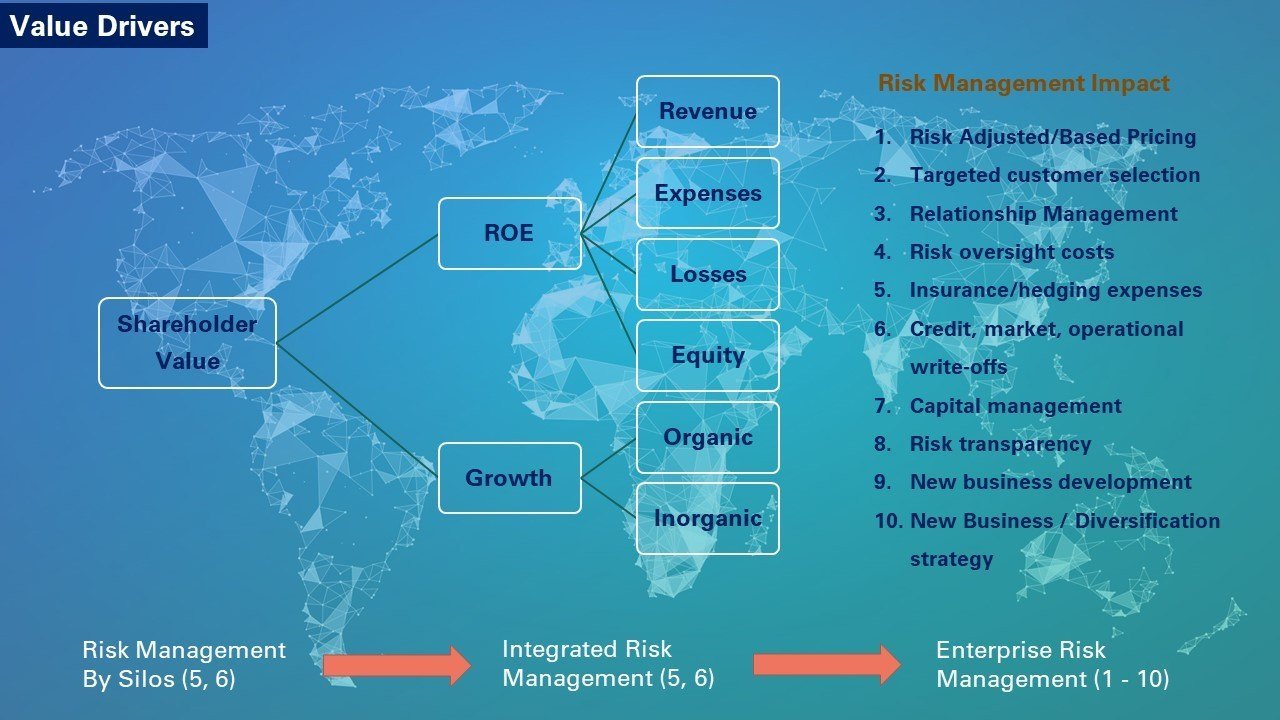
In addition to economic capital and RAROC (see my other article), companies deploy other methodologies to measure and manage strategic risk, such as net present value (NPV) calculations based on risk-adjusted discount rates or EVA® (Economic Value Added) models. The advantage of economic capital and RAROC models is that the analytical results are linked to earnings, capital management, and shareholder value maximization.
Originally published on LinkedIn, 13 June 2020.
Fayyaz Ahmad is the Founder and Principal of Keel Pragma. He has spent 27 years in senior risk leadership at global and leading regional institutions, building and running ERM, governance and GRC frameworks.
About Fayyaz →