
The Imminent Digital Disruption Risks Few Are Prepared For: A 2025 Perspective

Despite rapid advances in digital transformation and cybersecurity awareness, there remain several underappreciated and underregulated digital disruption risks that pose serious threats across industries. These risks often fall between traditional enterprise risk domains, making them harder to govern and monitor effectively. This white paper identifies and analyzes such imminent threats, quantifies their potential impact across industries in the U.S., and provides actionable strategies for resilience.
Underrecognized Emerging Risks
Here are ten key digital disruption risks that remain underappreciated by most organizations, governments, and regulators:
- AI Supply Chain Attacks: Corruption of AI models during training or fine-tuning stages.
- Synthetic Media as Cyberattack Vectors: Deepfakes used for fraud, impersonation, and disinformation.
- Algorithmic Dependencies in Critical Infrastructure: Smart systems operating without adequate oversight.
- Global DNS Infrastructure Attacks: Foundational DNS layer vulnerabilities.
- Quantum Computing Panic: Fear-based erosion of trust in encryption, even before actual threats materialize.
- Cascading Failures from API Abuse: Exploits spreading through interconnected APIs.
- Digital Certificate Authority (CA) Failures: Collapse of compromise of trusted PKI anchors.
- AI Hallucination Liability: Legal and operational fallouts from generative AI errors.
- Submarine Cable Cuts and Satellite Jamming: Physical threats to global connectivity.
- Gen AI-Powered Social Engineering: Realistic phishing and impersonation at scale.
These risks often overlap domains, which means they can evade traditional silos like cybersecurity, IT operations, or compliance. For further reading, see the Center for Strategic and International Studies (2023) on hybrid digital warfare, and the World Economic Forum’s Global Cybersecurity Outlook (2025).
Risk Scoring Methodology
Each risk was evaluated using the following metrics:
- Likelihood (1–10): Estimated probability of occurrence based on current technological and geopolitical trends.
- Impact (1–10): Potential disruption magnitude within a specific industry if the risk materializes.
- Risk Score: Calculated as Likelihood × Impact. Scores range from 1 to 100.
This method mirrors traditional risk heatmaps used in enterprise risk management (see COSO ERM Framework, 2017).
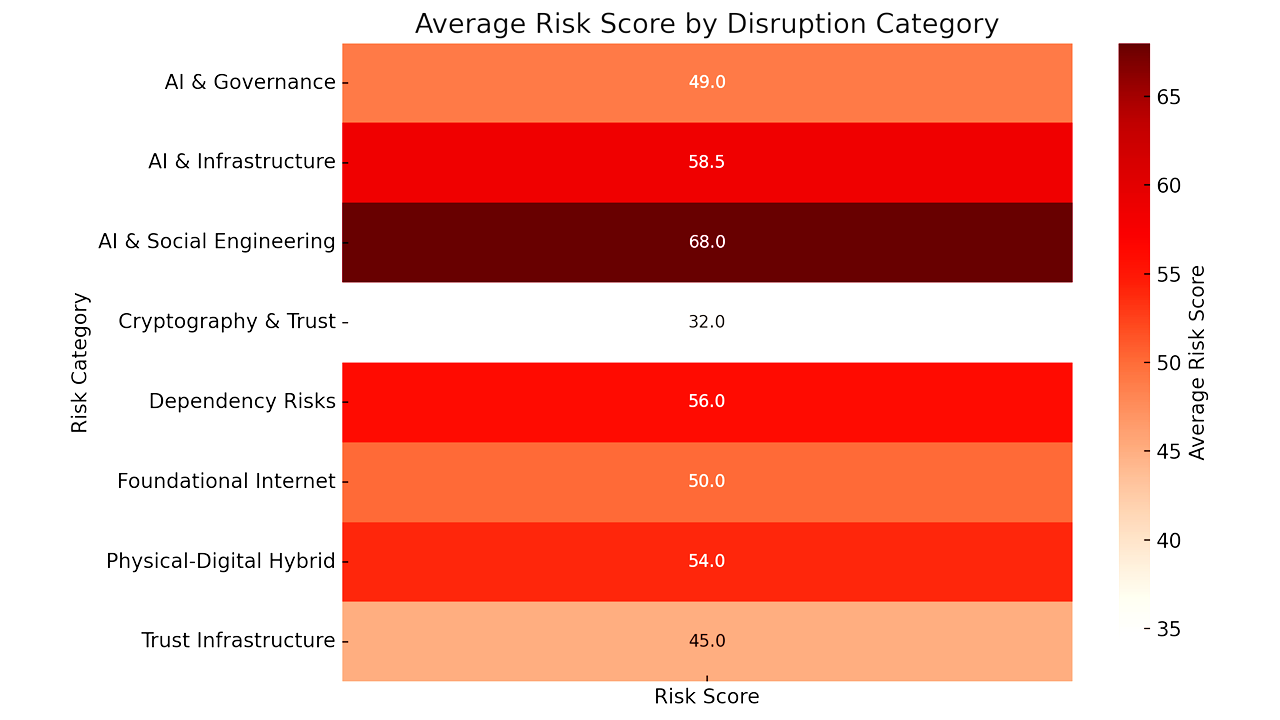
General Industry Heatmap by Risk Category – Global
First, we averaged risk scores by risk category across industries. Darker colors represent higher average risk scores.
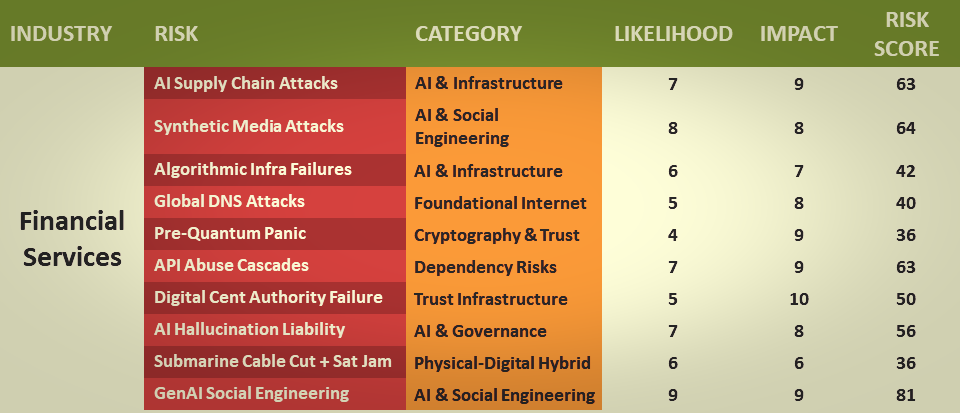
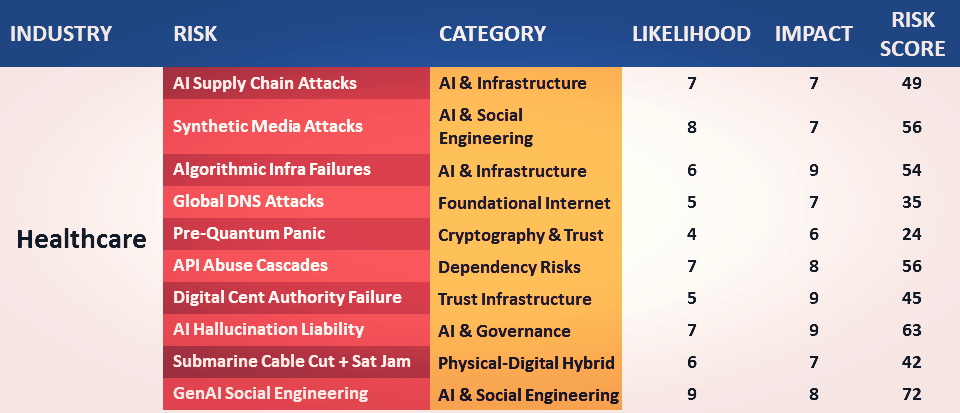
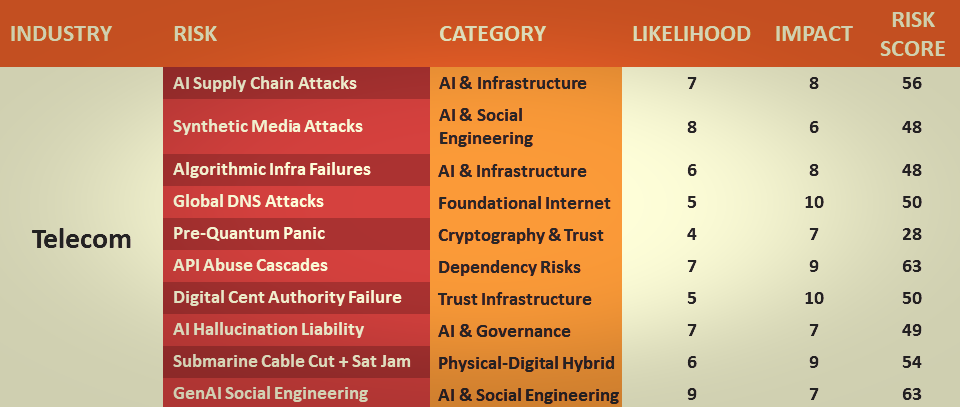
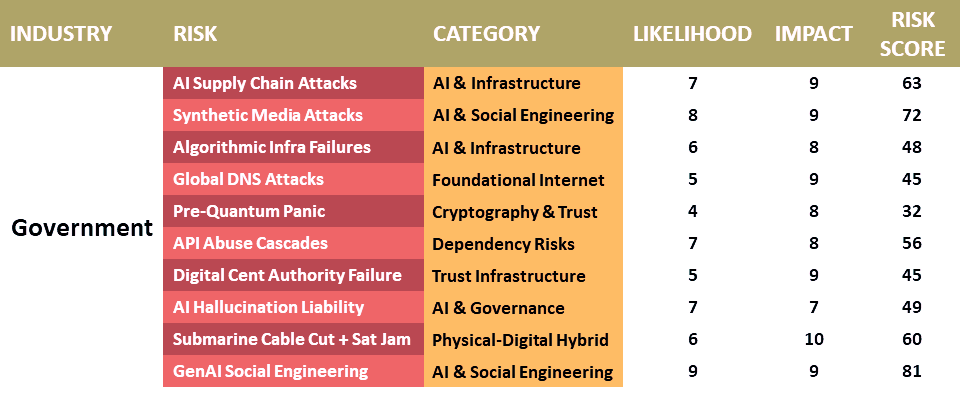
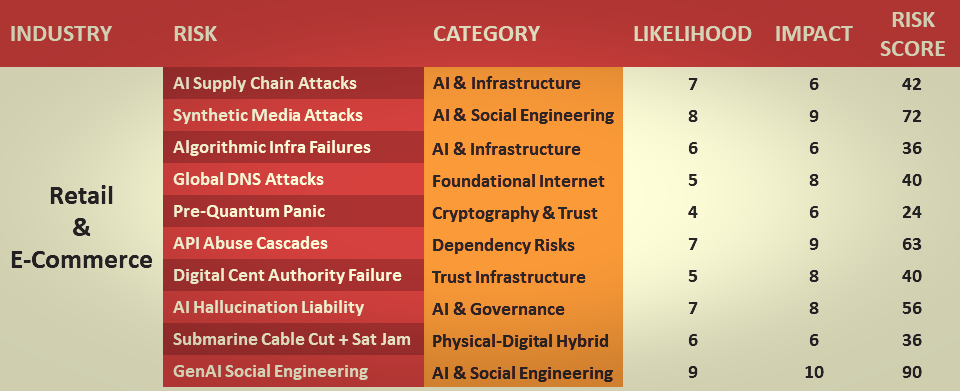
Detailed Global Industry-Wide Risk Scores
Below is a sample of risk scores calculated for each industry and threat. Scores range from moderate (35+) to very high (90+), which signals urgent mitigation is required.
U.S.-Specific Risk Scoring Adjustments
We adjusted impact ratings to reflect the United States’ infrastructure, regulatory exposure, and geopolitical sensitivity. For example:
- API cascades have higher impact in U.S. financial and retail sectors.
- DNS and CA-related disruptions are especially critical in telecom and government sectors.
Reference: U.S. Cybersecurity and Infrastructure Security Agency (CISA) Annual Threat Assessment (2025).
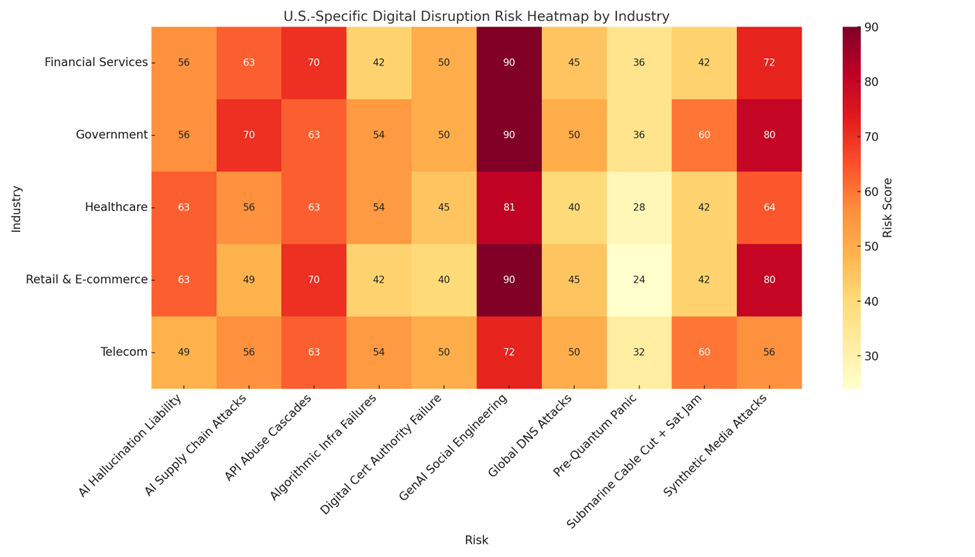
U.S. Industry Risk Heatmap
The heatmap below illustrates how digital risks vary across industries in the U.S. Darker colors indicate higher combined likelihood and impact scores.
Summary of Sectoral Priorities
Financial Services: Top risks include API Abuse, Synthetic Media Attacks, and GenAI fraud. Focus on zero-trust, API stress tests, and internal identity verification. Source: Financial Stability Oversight Council (FSOC) 2025 Report.
Healthcare: High exposure to AI hallucination, algorithmic infrastructure failures, and API exploits. Require robust model auditability and fail-safes. See HHS Cybersecurity Program Updates (2025).
Telecom: Vulnerable to DNS and CA failures. DNSSEC deployment and cert management protocols are critical.
Government: Highest overall risk—deepfakes, DNS attacks, submarine cable cuts. Needs enhanced crisis continuity planning. Refer to GAO Report GAO-25-138 on Federal Digital Infrastructure Resilience.
Retail & E-commerce: Prime target for GenAI social engineering and API compromises. Strong MFA, anti-bot layers, and vendor security checks are recommended.
Conclusion
The common pattern is that these risks are cross-domain and emerging faster than governance frameworks can catch up. They often don’t neatly fall into a single risk register category – cybersecurity, operational, compliance, or reputational – therefore fall through the cracks. Digital risk has evolved beyond perimeter security and regulatory checklists. The emerging threats outlined here demand:
- Cross-functional governance
- Real-time risk monitoring
- Forward-looking regulatory frameworks
Without urgent investment in foresight, stress testing, and adaptive controls, these imminent disruptions may catch even the most sophisticated organizations off guard.
For further reading and references:
– World Economic Forum. Global Cybersecurity Outlook 2025.
– U.S. CISA. National Cyber Threat Framework 2025.
– OECD. Emerging Technology and Risk Regulation Survey, 2024.
– Center for Strategic and International Studies. Cyber Conflict Trends, 2023.
– NIST AI Risk Management Framework, 2023.
Originally published on LinkedIn, 4 August 2025.
Fayyaz Ahmad is the Founder and Principal of Keel Pragma. He has spent 27 years in senior risk leadership at global and leading regional institutions, building and running ERM, governance and GRC frameworks.
About Fayyaz →