
The CRE Stress Test Paradox

The scenario design drove the result
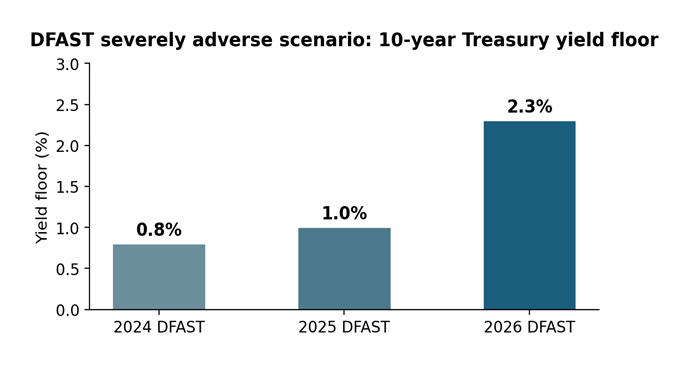
The cleanest aggregate capital result in six years was driven not by stronger bank portfolios but by the scenario’s interest rate assumptions. The 2026 severely adverse scenario set a floor for 10-year Treasury yields at 2.3% — nearly triple the 0.8% used in 2024. Higher assumed rates generated net interest income that offset credit losses on paper.

What is actually driving CRE stress
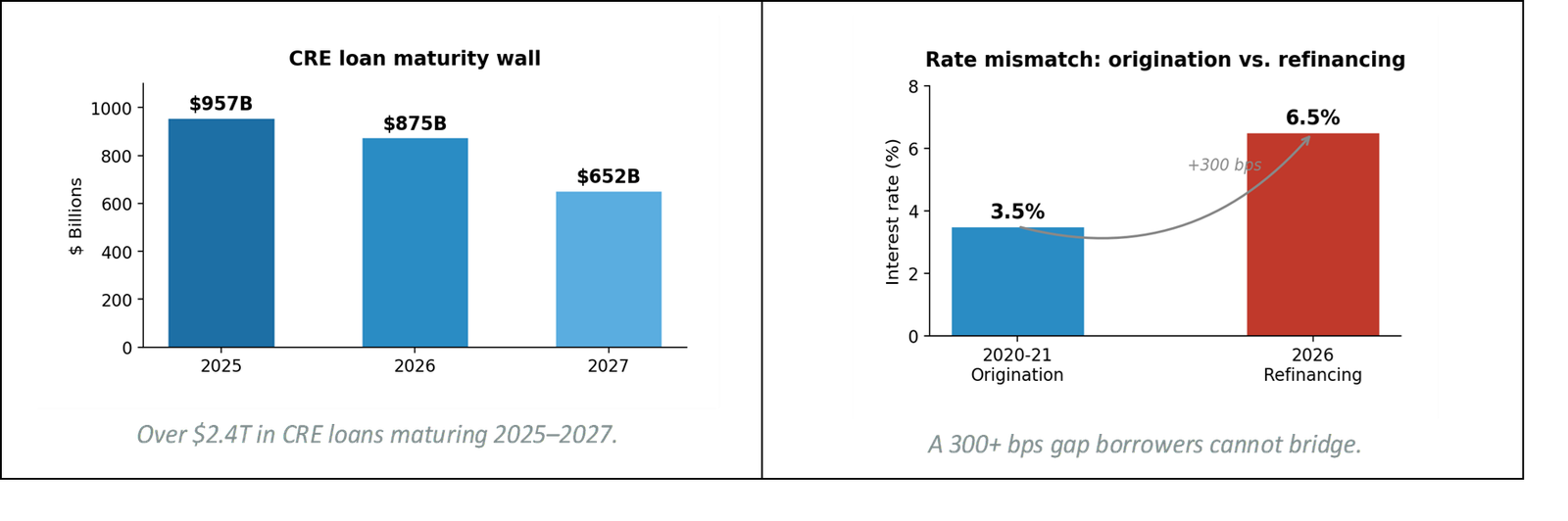
Three structural forces are converging simultaneously: a $2.4 trillion refinancing wall, a permanent demand shock in office, and a 300+ basis-point rate mismatch between origination and refinancing.
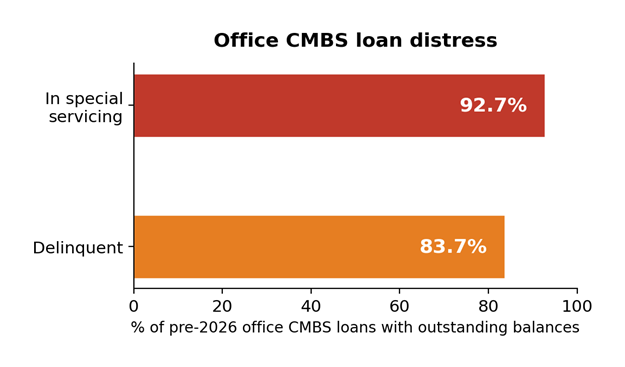
National office vacancy rates exceed 20% — the highest in forty years — with no trajectory toward recovery. Hybrid work has structurally reduced demand for office space per employee by 30–40% across major markets. Among office CMBS loans that matured before 2026 and still carry outstanding balances, the distress is near-total.
Three blind spots in the stress test
1. It tests the wrong banks
The heaviest CRE concentrations relative to capital sit at community and regional banks below the $100 billion DFAST threshold — institutions carrying CRE exposures at 300% or more of risk-based capital. The St. Louis Fed has confirmed this structural blind spot. The stress test produces reassuring results for the population that needs the least reassurance.
2. It cannot model the maturity-wall liquidity failure
A property that retains operational value but whose loan matures before refinancing can close in an adverse rate environment is a timing problem, not a credit-loss problem. That is the primary transmission mechanism for CRE stress today, and the stress test’s probability-of-default architecture cannot capture it.
3. It does not run the most plausible adverse scenario
The scenario the test excludes — CRE distress under rising rates driven by an inflationary supply shock — is exactly the environment that tariff escalation, sustained Strait of Hormuz disruption, or a second-round energy price spike would produce. Under that scenario, the NII cushion that saved the 2026 results becomes the pressure that accelerates loss crystallization.

The feedback loop nobody is modelling
There is a second-order transmission channel that is real, slow, and completely absent from every stress test and supervisory risk assessment published in 2026.
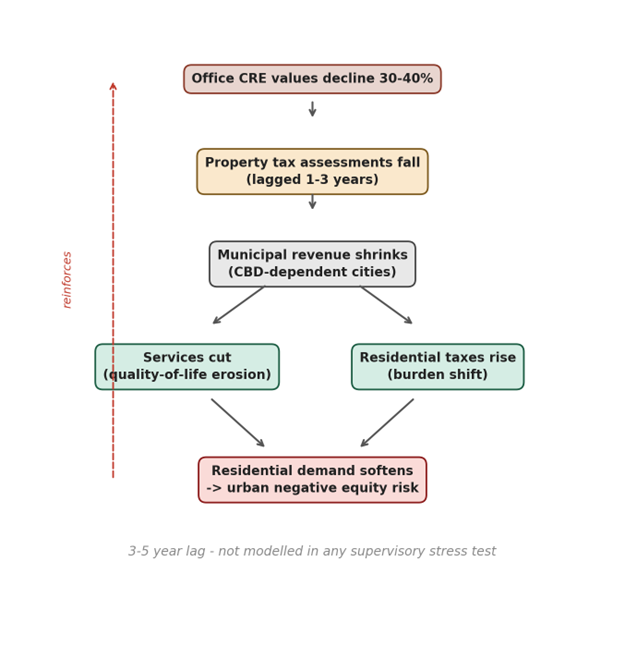
Cities dependent on commercial property tax revenue from office districts — New York, San Francisco, Chicago, Washington DC — face a fiscal transmission mechanism that connects CRE devaluation to residential real estate through the municipal balance sheet.
The logic is mechanical. Office values decline 30–40%. Commercial property tax assessments follow, on a lagged basis. Municipal revenue contracts. Cities either cut services or shift the tax burden to residential property owners. Either response pressures residential values — service cuts through quality-of-life deterioration, tax increases through direct cost burden.

The board-level question
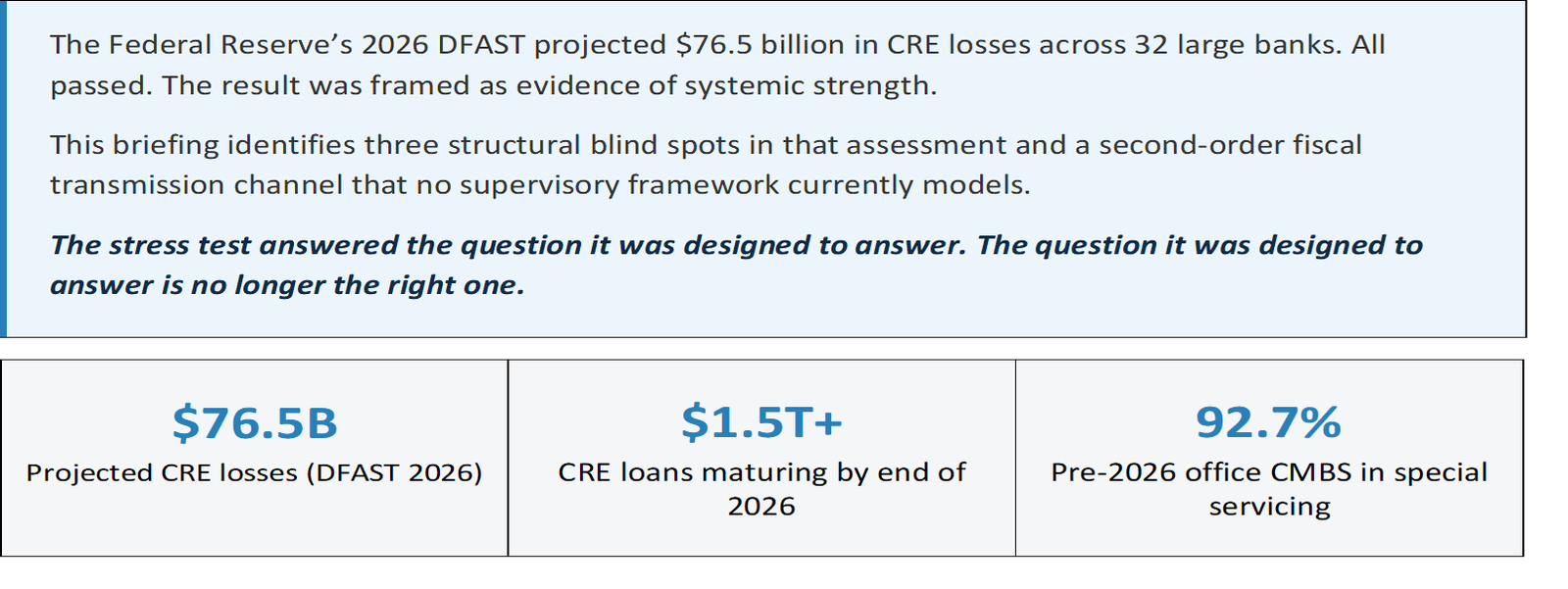
The $76.5 billion headline tells you the system can absorb a 39% blended CRE price shock. What it does not tell you is whether your institution, in your markets, with your concentration profile, can absorb the specific sequence of events the current environment makes most probable: an orderly workout timeline interrupted by an inflationary shock that keeps rates elevated through 2027–2028.
The stress test answered the question it was designed to answer. The question it was designed to answer is no longer the right one.
SOURCES
Federal Reserve DFAST 2026 • OCC Semiannual Risk Perspective (Spring 2026) • MBA Originations Data (Q1 2026) • FDIC Quarterly Banking Profile • NY Fed Staff Report 1130 • CoStar CMBS Analytics • Bank Policy Institute • Mortgage Bankers Association
Originally published on LinkedIn, 19 September 2026.
Fayyaz Ahmad is the Founder and Principal of Keel Pragma. He has spent 27 years in senior risk leadership at global and leading regional institutions, building and running ERM, governance and GRC frameworks.
About Fayyaz →