
Risk Adjusted Pricing Decisions

The most effective way for companies to ensure an appropriate return on the risks that they are willing to accept is to incorporate the cost of risk into their pricing methodologies. If the cost of risk (COR) is not fully reflected in the initial pricing (for example, if the product or transaction is underpriced relative to the risk), there is nothing the company can do to recover its costs. Risks that are underpriced may increase revenue and growth in the short term, but over time they will destroy overall product proposition and shareholder value.
Companies should include the following when quantifying full COR:
- Expected loss (EL), or average loss per year over a business cycle;
- Unexpected loss (UL), which can be defined as economic capital x Ke (cost of equity capital);
- Risk transfer costs (of hedging or insurance); and
- Risk management costs (that pertain to maintaining staff, systems, etc.).
For over 24 years, financial institutions have applied economic capital, risk-based pricing, and RAROC analysis in managing their businesses. Banks use these tools to measure risk-adjusted profitability and pricing for a wide range of products and services, including commercial loans, consumer loans, derivative products, and investment banking and brokerage services. But risk adjusted/based pricing is also a critical practice for non-financial companies. The Airbus case study shows the potential pitfalls when strategic programs do not fully account for the cost of risk.
How should a company respond if a close competitor decides to introduce a discount pricing strategy by charging a 2.2% margin (instead of 2.5%)? Risk adjusted/based pricing can be used to support that business decision. This is demonstrated in the following, where the math works backward or from bottom to top.
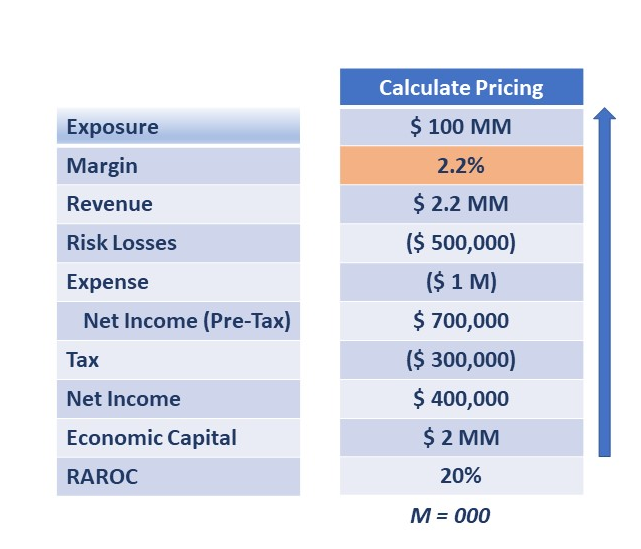
Say the company decides that a 20% RAROC is the minimum hurdle rate of profitability that it wants to achieve for this business. By applying the same methodology but in reverse, a 2.2% margin is calculated as the risk-based pricing that would achieve a 20% RAROC.
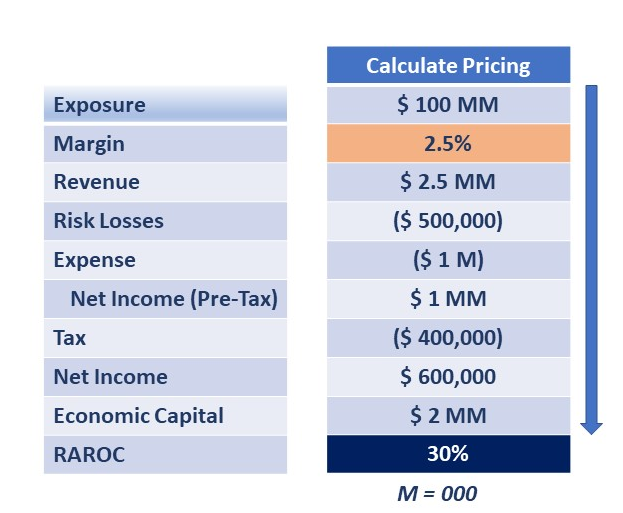
The 30% RAROC metric can be very useful in decision making in two ways.
- First, it can support product and customer management strategy. If RAROC is greater than Ke, then the transaction or customer is creating shareholder value and the company should increase this business. Conversely, if RAROC is less than Ke, then the transaction is destroying shareholder value and the company should discontinue this business, increase pricing of future transactions, or cross-sell more profitable products to the same customer to increase the overall RAROC of the relationship to be greater than Ke.
- Second, RAROC can support business management and resource allocation. The calculated RAROCs of different business units can be compared against each other because they provide a consistent risk-adjusted measurement of profitability. Other profitability measures—such as profit margin, ROA, and ROE—are not risk-adjusted, so any comparisons might lead to wrong conclusions. For example, a business unit with marginally lower ROA and ROE might be more attractive than another business unit if the former has a substantially lower risk profile. RAROC analyses support management decisions regarding which businesses to grow, maintain, fix, shrink, or exit.
Originally published on LinkedIn, 5 June 2020.
Fayyaz Ahmad is the Founder and Principal of Keel Pragma. He has spent 27 years in senior risk leadership at global and leading regional institutions, building and running ERM, governance and GRC frameworks.
About Fayyaz →