
Fintech in the GCC: 2025 Growth Outlook & Key Challenges

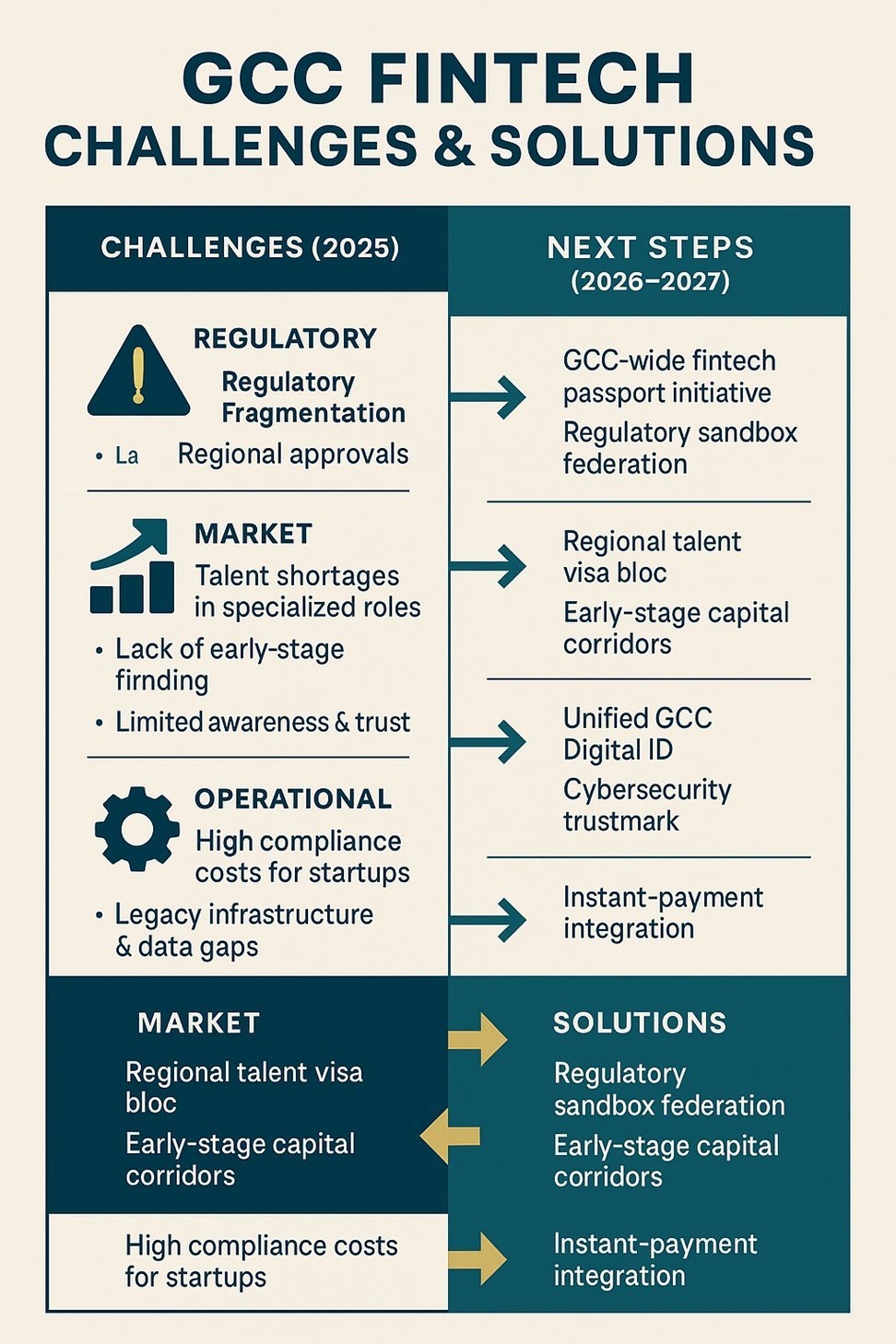
The Gulf Cooperation Council (GCC) remains one of the fastest-growing fintech regions globally, but scaling across markets still presents notable hurdles.
1. Regulatory Fragmentation & Uncertainty
Each GCC jurisdiction maintains its own licensing regimes, capital requirements, and market-entry rules. A fintech licensed in Saudi Arabia must still secure separate authorizations to operate in the UAE, Bahrain, Qatar, Kuwait, or Oman.
- Recent development: In 2024–25, the GCC launched a fund-passporting framework for investment funds, but no equivalent fintech license passport exists.
- Free-zone regulators (e.g., DFSA, ADGM, VARA) operate parallel to federal regulators, adding to complexity. This patchwork raises compliance costs and delays cross-border rollout.
2. Talent Shortages in Specialized Roles
Rapid fintech expansion continues to outpace the supply of experts in cloud architecture, APIs, blockchain, digital-banking integration, and cybersecurity.
- Strategy& (PwC) projects that to reach world-class digital-economy staffing levels, the GCC would need ~600,000 new tech jobs by 2030 — far exceeding current domestic pools. While skilled-worker visa reforms are helping, in-market availability remains constrained.
3. Access to Early-Stage Capital
MENA fintech attracted roughly $1.9 billion across 237 deals in 2023–24, but capital remains concentrated in late-stage rounds.
- Early-stage founders still report difficulty closing seed and Series A rounds, slowing grassroots innovation.
- Sovereign wealth funds and corporate VCs are increasing participation, but largely in mature players.
4. Legacy Infrastructure & Data Gaps
Credit-bureau coverage ranges from ~20 % to ~60 % of adults across GCC markets.
- Progress since 2024: KSA (SAMA): rolled out phased Open Banking Framework requirements. UAE (CBUAE): launched Open Finance Regulation in 2024, updated under Circular 03/2025, plus the Aani instant-payments platform. Bahrain (CBB): mandated open-banking compliance for licensed entities. These advances are narrowing data-sharing gaps, but digital ID systems and interoperability are not yet uniform.
5. Cybersecurity & Data-Privacy Risks
The surge in digital transactions has heightened exposure to fraud, hacking, and breaches.
- Data-protection laws vary by country: Saudi PDPL, UAE federal DP law, Bahrain PDPL, and frameworks in Qatar, Oman, and Kuwait differ in scope and enforcement.
- Digital-asset regulation divergence: Dubai (VARA): comprehensive VA rulebooks in force. ADGM/DFSA: updated crypto frameworks. Bahrain (CBB): continued VA licensing regime. Qatar QFC: issued Digital Assets Regulations 2024. Oman: drafting VA framework. Kuwait: restrictive stance continues.Fintechs operating region-wide must tailor compliance to each jurisdiction.
6. Limited Consumer Awareness & Trust
High mobile penetration has not eliminated skepticism toward non-bank providers. Many consumers still default to traditional banks over concerns about fintech reliability.
- Bridging the gap requires sustained education, marketing, and partnerships with established institutions.
7. High Compliance Costs for Startups
Ongoing regulatory evolution — from open-banking/finance to AML “Travel Rule” enforcement — demands continuous legal, audit, and reporting resources.
- Smaller firms often allocate a disproportionate share of budgets to compliance versus product development.
8. Intense Competition & Partnership Dynamics
Legacy banks are accelerating digital transformation, acquiring or partnering with fintechs, and competing aggressively in payments, lending, and wealth-tech.
- Independent players must specialize or secure complex alliances, each with its own operational risks.
Pathways to Sustainable Cross-Border Growth
- Regulatory alignment: Explore GCC-wide fintech-passporting modeled on the new fund-passport framework.
- Talent pipelines: Expand public–private tech academies and targeted visa programs.
- Capital access: Boost sovereign-backed early-stage funds.
- Infrastructure integration: Harmonize digital-ID systems and open-finance standards.
Bottom line:Regulatory progress in open banking/finance and payments is reducing certain frictions, but licensing fragmentation, compliance divergence, and funding gaps remain the core barriers to unlocking the GCC’s full fintech potential.
Originally published on LinkedIn, 13 August 2025.
Fayyaz Ahmad is the Founder and Principal of Keel Pragma. He has spent 27 years in senior risk leadership at global and leading regional institutions, building and running ERM, governance and GRC frameworks.
About Fayyaz →